

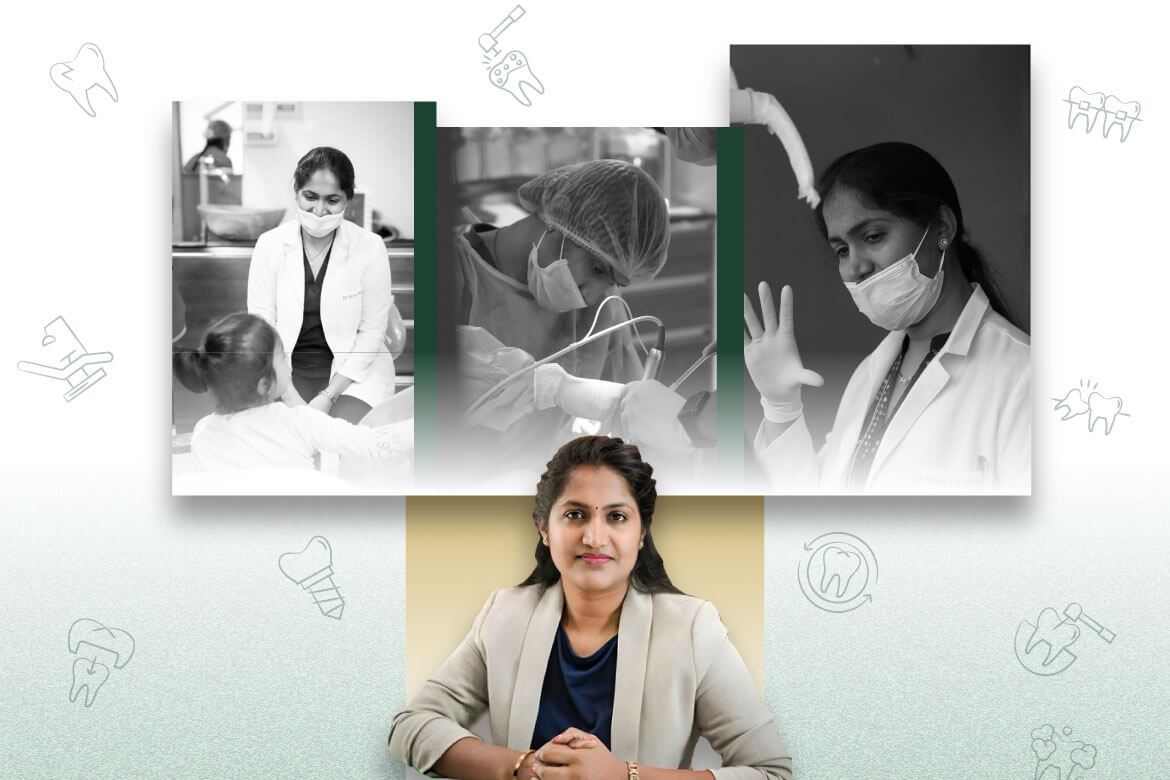

A Dentist’s Perspective: The Oral Health Signs Patients Ignore
Over the past twelve years in dentistry, I have learned to recognise a moment that repeats itself often.
A patient sits down, lists a complaint, a tooth that feels slightly off, gums that bleed a little in the mornings, a jaw that clicks when they eat, and then immediately says, “but it’s probably nothing.”
They are almost always wrong. Not because the symptom is serious by itself, but because by the time something feels like something, the body has already been negotiating quietly for months. Sometimes years.
In practice, this pattern shows up in ways many patients don’t immediately connect:
Bleeding gums during brushing are often blamed on brushing too hard, but they are frequently the first sign of gum disease that can progress to bone loss around teeth.
A missing tooth that feels manageable slowly allows neighbouring teeth to shift and tilt, gradually destabilizing the entire bite.
Occasional tooth sensitivity may seem minor, yet it often signals enamel wear or gum recession exposing the tooth’s vulnerable inner layers.
Jaw clicking while chewing is rarely just a sound, it can indicate strain in the jaw joint that may develop into chronic TMJ problems.
Individually, these signs feel small.
But together, they tell a story.
Over the past twelve years in dentistry, I’ve learned to recognize that quiet negotiation. First as a student at Drs. Sudha and Nageswara Rao Siddhartha Institute of Dental Sciences, through my MDS in Prosthodontics at Saveetha Dental College under Dr. Deepak Nallaswamy, and now daily practice at my clinic in Kondapur, Hyderabad, one thing has become clear to me:
The mouth is a patient narrator.
It rarely shouts.
It leaves clues.
My role is to recognize those clues before they turn into a crisis.

The Pattern Nobody Told Me About in Dental School
My formal training sharpened my clinical eye. Prosthodontics is a discipline of reconstruction, rebuilding what is lost, restoring what has failed. But the more I practiced, the more I noticed something that textbooks do not quite prepare you for: most of the damage I was reconstructing was preventable. Not because patients were careless, but because no one had ever told them what to look for early enough.
Gum bleeding dismissed as normal. A missing molar treated as cosmetic, not structural. A bite that shifts over months because the surrounding teeth have quietly tilted into the gap. The system adapts. And then one day, the adaptation runs out of room.
I chose to specialise in implantology because it sits right at that intersection, the point where the damage has been done and the work of rebuilding begins. Becoming Hyderabad’s first woman Strategic Implantologist was not just a professional milestone. It sharpened a responsibility I had already begun to feel: that replacing a tooth is never just filling a space. It is re-entering a system that has been compensating, and you have to understand what it has been compensating for.
That requires working backwards before you work forwards.
What "Strategic" Actually Means at the Chair
I am often asked what makes an implant approach “strategic.” The honest answer is that the strategy begins before anything touches the patient’s mouth.
Prosthetic planning dictates placement, not the other way around. Before I consider angulation or bone density, I am asking: what does the final restoration need to achieve? How will this bite function in five years? What forces will this implant absorb, and is the surrounding architecture strong enough to support them long-term?
This is also why I will sometimes tell a patient that the most responsible thing I can do for them today is not place an implant yet. Soft tissue needs to stabilise. Bone support needs to be assessed. If the gum environment is inflamed, restoring on top of it is building on uncertain ground. Sequencing matters more than speed.
This restraint is not hesitation. I have learned to be clear about that distinction — with myself and with my patients.
The Child Who Changed How I Think About Fear
There is one case I return to often in my own mind, because it shifted something in the way I work.
A young girl came in with her mother, visibly terrified. The clinical problem was straightforward, a cavity that needed addressing. But she was so frozen with fear that proceeding directly would have solved the cavity and calcified a lifetime of dental anxiety.
I made a decision in that moment to put the procedure down and pick up a conversation instead. Not about teeth, not about the treatment. Just about her. What she liked, what felt safe, what she needed to feel less alone in that chair.
By the time we finished that day, she had not just tolerated the treatment, she had participated in it. Calm enough to cooperate. Trusting enough to return.
I think about that exchange every time I work with a patient who comes in braced for something difficult. Fear is not an obstacle to treatment. It is information. It tells me how much trust I need to build before precision can do its job. Because the most technically perfect procedure, performed on a patient who is rigid with anxiety, will not heal the way it should.
Calm is not just kindness. It is clinical strategy.
What Twelve Years Has Confirmed
I hold a PhD, multiple national and international certifications – FICOI, MICOI, CCBPS, CCENDO – and have been recognised by the World Dental Congress and ICOI USA. I mention these not to fill space, but because each one represents a question I was not yet able to answer, and the pursuit to answer it properly.
The ICOI fellowship deepened my understanding of implant biomechanics at a level that changed how I plan cases. The research recognition from the World Dental Congress came from work that continues to inform how I think about bone behaviour and long-term prosthetic stability. The certifications in endodontics and periodontics remind me that a prosthodontist who works in isolation from the broader oral ecosystem is only seeing half the picture.
What twelve years has confirmed, more than anything else, is that the patients who do best are the ones who understand why a treatment is being sequenced the way it is. When clarity replaces uncertainty, cooperation improves. When cooperation improves, outcomes improve. It is not a soft observation, it is something I have seen hold true across hundreds of cases.
The Standard I Hold Myself To
I do not consider a case complete on the day a procedure ends. I consider it complete when function is stable over time, when the tissue has healed the way it should, when the bite is balanced, when the implant is bearing load without incident eighteen months later.
That longer view is what I mean when I say I plan dentistry for years, not visits.
Every decision I make passes through one question: will this remain stable over time? If the answer is uncertain, I reassess. I have turned down approaches that were technically feasible but biologically uncertain. I have slowed timelines when rushing would have been commercially easier. I have referred cases when the right next step was outside what I could offer.
That is not constraint. That is what I believe responsible dentistry looks like.
The mouth keeps its own record. After twelve years, so do I.